
New book on Golda notes NA’AMAT’s critical role in shaping her career
By Sharon Sutker McGowan
In 1928, Golda Meir was chosen by labor leaders in Palestine to go to the United States for six months as an emissary to the fledgling Pioneer Women organization. Golda, who was born in Russia but grew up in Milwaukee, visited clubs throughout the country, sleeping at members’ homes and inspiring them to raise money for women workers’ farms in Palestine. Golda identified with the Pioneer Women, who, like her, were working class and spoke Yiddish.
“Her activities with this organization (Pioneer Women) formed the fulcrum of who she was at the time and who she became later. Although she had left America behind her, it was there, in that country, among these women and because of them that her star began to shine most brightly,” writes Francine Klagsbrun in “Lioness: Golda Meir and the Nation of Israel,” published in October.
Golda learned to be a leader by working with Pioneer Women and with the Women Workers’ Council (Moetzet Hapoalot) in Israel, said Klagsbrun in a phone interview with NA’AMAT Now. “If she hadn’t had that opportunity, who would she have led? Men’s organizations would not have had a woman leader. That was beginning of her trek up the ladder.”
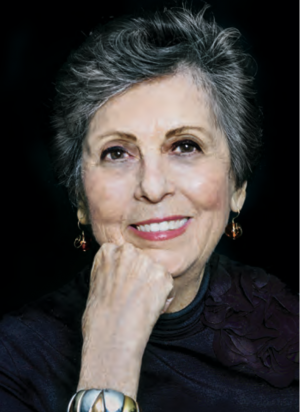
Klagsbrun praises Golda for her intelligence, political skills and ability to “rise to the occasion to cope with the issue of the moment.” For example, although she was severely criticized for the loss of life resulting from the surprise Yom Kippur 1973 attack on Israel, Golda made military decisions that helped win the war. She held the country together, Klagsbrun said. “She was a rock when Moshe Dayan fell apart.”
Klagsbrun said she admires Golda for her single-minded dedication to creating a home for the Jewish people. “She worked very hard and whatever job needed to be done, she was there to do it,” she said. Golda lived modestly and never took advantage of her position to benefit herself or her family.
“She was not an ideologue who wanted to take over all the land the country captured,” Klagsbrun said. Although she was a tough negotiator, she was open to negotiations because she truly wanted to make peace with Arab leaders.
Her accomplishments spanned every stage of her career. As Minister of Labor, she helped house tens of thousands of immigrants, instituted paid maternity leave and pushed through a progressive national insurance act that became the basis for the social security system in Israel today. She was instrumental in fostering the movement to save Soviet Jewry, and is credited with the immigration of a million Soviet Jews to Israel.
Klagsbrun’s 824-page book also details Golda’s failings. For example, in contrast with her efforts for Soviet Jews, Golda was unable to “put herself into the head of someone very different than she,” Klagsburn said, citing her indifference to the needs of Jews from Muslim lands, and her failure to recognize the beginnings of Palestinian nationalism.
Perhaps the biggest irony is that although Golda became a feminist icon as Israel’s first woman prime minister, she rejected feminism. She did not want to be seen as a “woman leader,” Klagsbrun writes, “but like any man, simply as a leader whose achievements resulted from hard work and devotion to ideals.”
Although she pushed through laws to help women, she didn’t identify with the women’s movement, and was continually battling with women leaders in Israel who were devoted to feminism and intent on building women’s agricultural farms. “That was not Golda’s focus; her focus was the man’s world,” said Klagsbrun.
Golda didn’t believe that her ambitions were served by embracing feminism. In the “male-dominated world of Labor politics,” Klagsbrun writes, she thought “concentrating primarily on women’s concerns could be a barrier to moving ahead.”
“It’s too bad,” Klagsbrun said. “She could have been a great help if she had aligned herself with feminism, or even not spoken against it. She didn’t understand it; she was so intent on her own ambitions. That’s really unfortunate.”

Golda’s antipathy toward feminism extended to the way she viewed her own life. Klagsbrun writes, “So determined was Golda to set herself apart from women as a group that she told (Italian journalist Oriana) Fallaci she had ‘never belonged to a women’s organization,’ although she had actually headed two women’s organizations, the Women Workers’ Council in Israel and the Pioneer Women, it’s American counterpart.”
Klagsbrun criticized Golda for this. “By the time she had that interview (in 1972) she had made it already — why deny those origins?” she said. “It’s a failing on her part, but I can understand it. She wanted to make it in a man’s world.”
There is no disputing that she did, in fact, make it in a man’s world.

Advocacy
Is shalom bayit possible in light of domestic violence?
By Marcia J. Weiss, J.D.
Vice President, Advocacy
Shalom bayit (“peace in the home” or “marital harmony”) is one of the highest values in Judaism. It is also the value most compromised by domestic violence.
An estimated 1.3 million women in the United States are victims of physical assault by a partner each year, and 85 percent of domestic violence victims are women. A rape is reported every 6.2 minutes, although the actual total may be five times higher because most cases are never reported to the police.
Dating and domestic violence statistics are staggering: one in four girls is sexually abused in childhood; one in five college-age women is a victim of violence by an intimate partner. Reports of child abuse are made every 10 seconds in this country. There is evidence that a child who witnesses domestic abuse will experience trauma and develop emotional and behavioral symptoms. Witnessing violence committed by parents often results in transferring violent behavior to children when they reach adulthood. Statistics indicate that 30 to 60 percent of domestic violence perpetrators in a household also abuse children.
The Jewish community is not immune from domestic violence. Studies show that domestic violence happens among Jews at the same rate as in the general community (one out of every three women). Jewish women, however, stay in a relationship longer than the average: about 15 years.
NA’AMAT USA is committed to the right of women to be free from domestic abuse. In light of the overwhelming statistics, various Jewish organizations in the United States have been established to create justice for those who have been abused and help survivors to empower themselves. They offer peer support, spiritual counseling and education, prevention strategies and technical assistance, and serve as resource centers for networking built on Jewish values. NA’AMAT USA funds such a program in Israel to combat domestic violence and achieve shalom bayit.
Fundraising
New TECH4TEENS campaign geared toward Bar/Bat Mitzvahs
By Susan Brownstein
and Jan Gurvitch
Co-Vice Presidents, Fundraising
When you make a donation to NA’AMAT USA, you are empowering women and helping to improve the lives of women, children and families in Israel.
Our latest national fundraising project, TECH4TEENS, is designed to celebrate the Bar/Bat Mitzvah milestone by helping to provide equipment to our technological schools for students who lack basic equipment that we take for granted.
We also have partnered with Authentic Israel Tours, which can make arrangements for you to visit one of our NA’AMAT facilities when you join one of their tours to Israel. Contact Avi Green at [email protected] or 202-537- 6056 for more information.
NA’AMAT USA works diligently to meet the many challenges of supporting our programs in Israel. Your ongoing monthly gift as a Sustaining Partner plays a key role in enhancing the lives of the women, children and families in Israel. This gift can be made on an annual or monthly basis online using a safe, reliable and convenient donation mechanism. Or you can send a check to NA’AMAT USA, 6505 Wilshire Blvd, Ste 635, Los Angeles, CA 90048.
Become a Sustaining Partner today. Your continued contribution will make an important difference in the lives of the people we serve in Israel. And please get involved in our latest fundraising campaigns. Contact your local council or the national office at 818-431-2200, or visit naamat.org for donation information.
Membership
Online membership makes it easy for busy women to get involved
By Gail Simpson
Vice President, Membership
Interest in joining NA’AMAT is on the rise. Don’t be afraid to ask your friends to join! We now have two new exciting types of membership. Our new online club – eNA’AMAT – is up and running. It is designed for women who do not have time to go to meetings or plan events. They are busy with their careers or raising kids. We know that they do everything online, so why not give them an online NA’AMAT club? After signing up, women can go to the members-only Facebook page to read our latest posts. They can respond and converse with other members. There will be interesting articles, recipes and, of course, information about NA’AMAT Israel.
If you know someone who was gifted with a life membership but does not participate in a club, she may be interested in eNA’AMAT. Let us know her name so we can welcome her into this new club. For new members, dues for eNA’AMAT is a one-time donation of $90 payable over six months. So spread the word.
Israel is turning 70! If you’re a Life Member, celebrate by donating $70 to become a Platinum Life Member. Annual members can upgrade to Platinum Life for $320! You will be recognized in the NA’AMAT Now newsletter, and you will receive a membership card. Look for more information on our website.
We are so excited to announce our two new clubs. Rimonim, in Philadelphia is one year old. If you know women in the Philadelphia area, inform them about this club. Contact Deanna Migdal at Deanna. [email protected] or 818-431-2200.
The Mitzvah club, in Phoenix was chartered in September. Many of the members have been involved in NA’AMAT in the past. Tell your friends who go to Phoenix about this club. Want to start a new club? Let us know and we will help you!
Message from the President
By Chellie Goldwater Wilensky
President
I am so happy to be able to greet my NA’AMAT USA chaverot in our first newsletter. Though we were all very sad to have to stop publishing NA’AMAT Woman, we hope you will like our new newsletter and find it informative and enjoyable. It will come out three times a year.
On Oct. 30, NA’AMAT Israel dedicated our new Women’s Empowerment Center in Sderot. This was NA’AMAT USA’s very successful 90th anniversary project. Liz Raider, our past national president, represented us at this wonderful and exciting dedication. We hope this center will become a focal point for all the women of Sderot and we pray they will be able to use it in safety.
I went to Israel on Oct. 29 for the NA’AMAT International meeting and the World Zionist Organization (WZO) meeting. At the NA’AMAT International Meeting, I met NA’AMAT chaverot from Belgium, Brazil, Canada, Mexico, Peru and of course the United States. It was wonderful meeting these women and learning how NA’AMAT operates around the world.
The WZO met on Nov. 2, which was the 100th anniversary of the Balfour Declaration. That declaration read, in part, “His Majesty’s Government view with favor the establishment in Palestine of a national home for the Jewish people.”That was the first international recognition of the Jewish right to Palestine, and was brought about with the help of the WZO. It was very exciting to be in the flourishing State of Israel on that special anniversary.
On my way to Israel, I had a wonderful experience. While speaking to an Israeli flight attendant, I mentioned that I am the national president of NA’AMAT USA and I was going to Israel for only three days to attend the International NA’AMAT meeting. She said that was nice and then was called away. Ten minutes later she came back to say she loved NA’AMAT. She grew up in Haifa and her parents were of very modest means. Her mother went to a NA’AMAT summer camp and had the best time of her life doing craft projects and spending time on herself. She said it meant a lot to her mother, and she was so grateful to NA’AMAT for giving her mother this wonderful experience.This made me realize yet again how valuable the work we do for NA’AMAT USA is, because it helps make experiences like that possible.
Wishing you a Happy Chanukah and a peaceful 2018.
Club Activities